




Why Elevator Inspection Compliance Is So Complex in the U.S.
By Jamie Welsh | Certificate Management
Managing elevator inspections at one property can be challenging. Managing them across multiple buildings is even harder, even when those buildings fall under the same Authority Having Jurisdiction (AHJ). More equipment, more inspection dates, more documentation, and more coordination all increase the administrative burden. And when a portfolio spans multiple AHJs, that complexity grows further because the rules, timelines, filing steps, and even inspector models can vary from one location to the next.
In this blog, we’ll break down why elevator inspection compliance becomes so difficult, where the process typically gets stuck, and what building owners can do to stay ahead of it.
What is an AHJ?
An AHJ is the authority that oversees elevator code enforcement in a specific area. Depending on where your building is located, that could be a city, county, or state agency. The AHJ decides what code applies, how often inspections happen, who is allowed to perform them, what paperwork is required, and what happens when something is late or incomplete. That is why “elevator inspection compliance” is not one nationwide process. It is a patchwork of local systems.
The patchwork problem for building owners
Most jurisdictions build from the same general code family, including ASME A17.1, but that does not mean the rules feel the same everywhere. Jurisdictions adopt different code editions at different times, add local amendments, and may enforce similar rules in different ways.
In practice, that means a process that works at one property may not work at another: Two buildings with identical elevators — same manufacturer, same age, same condition — can face completely different compliance requirements depending on where they’re located.
For multi-site portfolios, this is where compliance gets complicated fast. You are not managing one standard. You are managing many.
Inspection frequency is only part of the story
You may think of compliance as “the annual elevator inspection,” but the calendar is often more layered than that. Depending on the AHJ, inspection requirements may include:
- Annual inspections
- Semi-annual inspections in certain jurisdictions
- Additional safety testing cycles
- Separate requirements for different types of equipment
Many jurisdictions also require recurring safety tests such as Category 1 and Category 5 testing. The Category 1 test is a No-Load test where the operation of the elevator is tested without weight. The Category 5 test is the Full-Load test where weights are added to the device to meet the full weight capacity to ensure safety remains when the elevator is at its maximum load.
These tests are conducted by the maintenance company or a specified testing company but may need to be witnessed by the inspector depending on the AHJ. When witnessed testing is required, the inspector performs the “Inspection & Witnessing,” while the mechanic conducts the tests.
Complicating matters further, terminology is not always consistent. What one jurisdiction calls an “annual inspection” may include testing requirements that another jurisdiction treats separately.
The result is that teams may believe they are covered when they still have another deadline approaching.
Who performs the inspection depends on the jurisdiction
Another layer of complexity comes from who is allowed to perform elevator inspections.
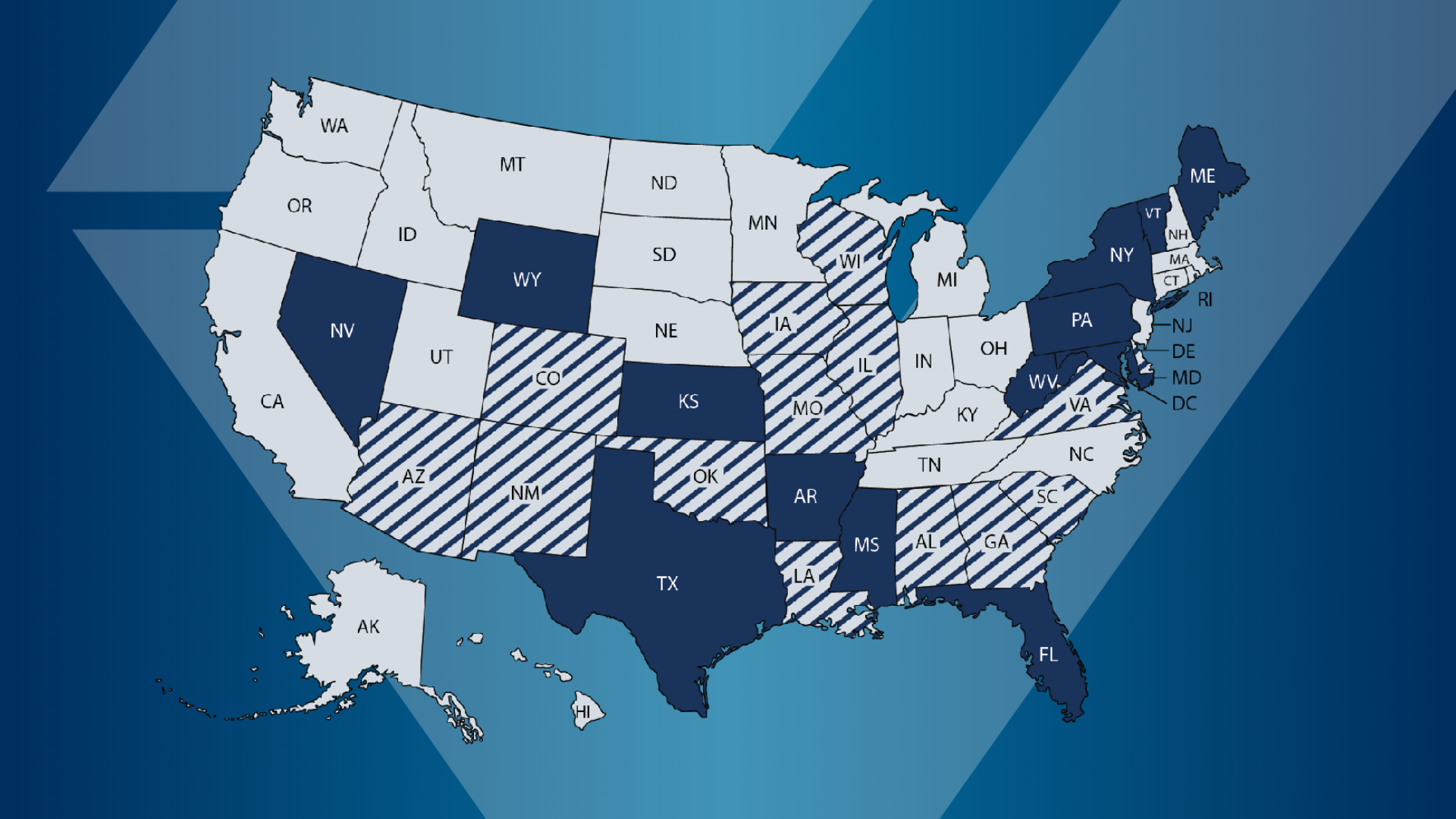
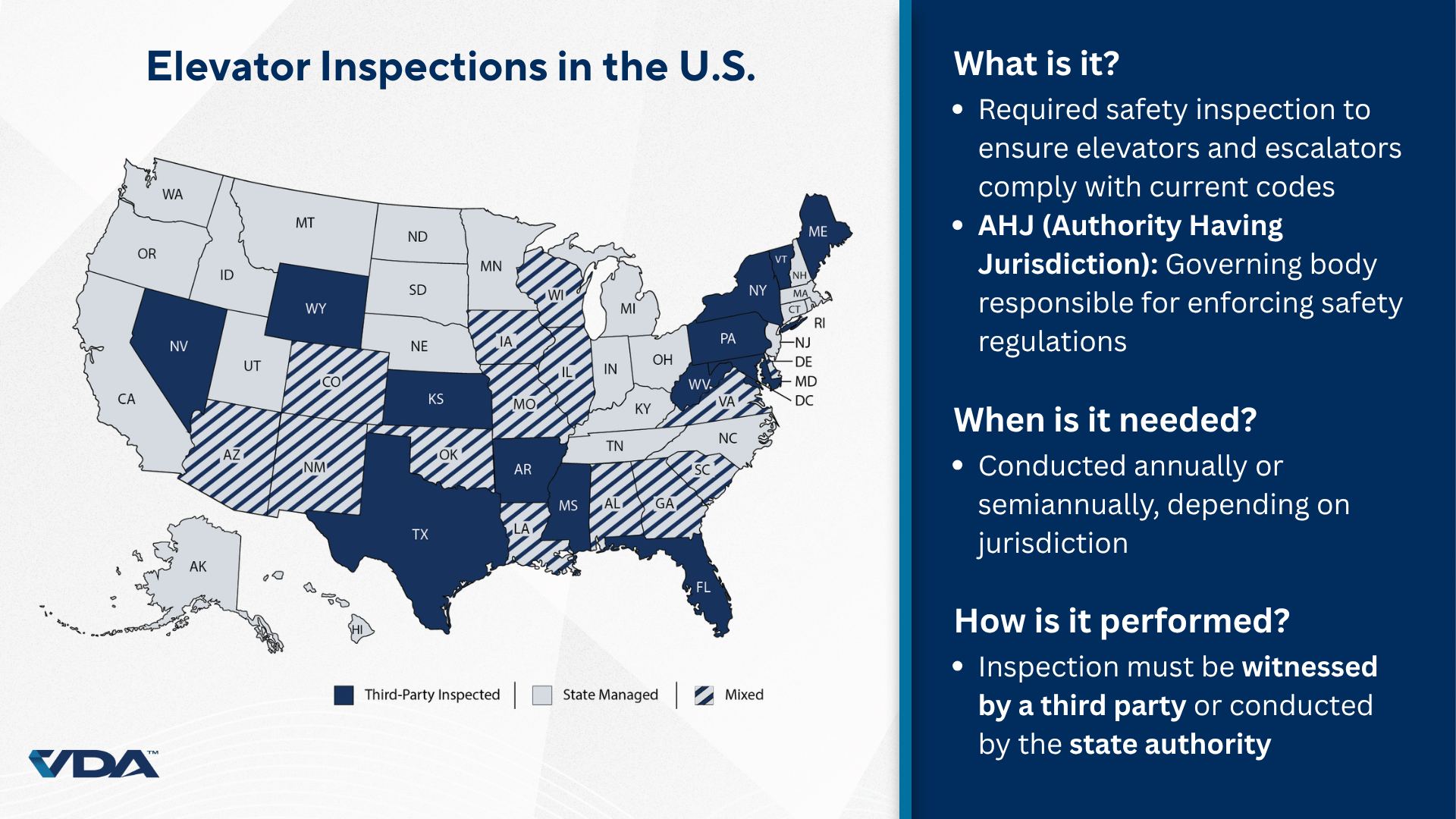
Across the U.S., there are three primary models:
- State-run inspections – performed by government inspectors
- Third-party inspections – performed by certified independent inspectors
- Hybrid models – a mix of both
This changes more than just who shows up on inspection day. It affects scheduling, lead times, re-inspection coordination, and communication.
If you manage multiple properties in different jurisdictions, you’re likely dealing with all three models at once, which makes standardization difficult.
The real burden is coordinating the end-to-end inspection process
The inspection itself is only one step in a much longer workflow. A typical inspection process includes:
- Make pre-inspection preparations
- Schedule a date with the elevator inspector and coordinate with the building, maintenance provider, and sometimes other vendors
- Inspection takes place
- Receive reporting results
- Address deficiency corrections, if needed
- Coordinate reinspection, if required
- Pay fees and file documentation
- Confirm the certificate is issued and posted
Each step involves coordination between multiple parties, including the building owner or facilities team, the elevator maintenance provider, the local AHJ, elevator inspectors, and in some cases additional vendors.
The process can stall at any handoff, which is why administrative follow-through matters just as much as the inspection itself.
Where the inspection process often breaks down: Violations
Inspections do not always pass cleanly the first time. Instead, elevator inspectors identify violations (sometimes called deficiencies) — items that must be corrected before full compliance is achieved.
This is where many organizations struggle.
Common challenges include:
- Unclear ownership of corrective actions
- Delays in receiving or understanding inspection reports
- Confusion over which items require reinspection
- Missed deadlines for correction
One of the most frequent issues is assumption. The building team assumes the contractor is handling it; the contractor assumes the building team is managing it.
On top of that, some jurisdictions require fees or filings to be completed before a certificate is issued. Miss one administrative step, and the result can be penalties, delayed certificates, or even shutdown risk. For owners, the exposure is not only technical. It’s operational and financial too.
Ready to dig deeper?
Watch our on-demand webinar, Mastering Elevator Compliance: A Focus on Maintenance & Inspections.
Why the inspection process becomes so difficult at scale
For a single building, elevator inspections can often be managed with careful attention. But across a portfolio, the complexity multiplies quickly. Each property may sit under a different AHJ, follow a different inspection cadence, require different forms of documentation, and rely on different vendors, inspectors, and communication norms. What might be manageable in one location becomes harder to standardize when every jurisdiction operates a little differently.
At the same time, the information needed to manage compliance is often scattered across emails, spreadsheets, paper records, and vendor systems, making it difficult to maintain a clear, current view of portfolio-wide status. Without that centralized visibility, even basic questions become hard to answer:
- Are all inspections up to date?
- Which properties have open violations?
- Where are certificates missing or expired?
In many cases, teams only discover problems when something has already gone wrong.
How to stay ahead of AHJ complexity
The best way to simplify elevator inspection compliance is to treat it like a system, not a once-a-year event, and to shift your approach from reactive to proactive.
Here are five steps to help you manage your elevator inspection process:
1. Map Your Jurisdictions
Understand which AHJ governs each property and what that means for:
- Inspection frequency
- Testing requirements
- Filing timelines
2. Track All Requirements, Not Just Inspections
Include:
- Safety tests
- Re-inspections
- Filing deadlines
- Fee payments
3. Define Ownership Clearly
Establish who is responsible for:
- Scheduling inspections
- Managing & clearing deficiencies
- Submitting documentation
- Paying fees
4. Centralize Information
Keep all compliance data in one place:
- Inspection reports
- Certificates
- Violation lists
- Status updates
5. Start Early
- Preparation should begin months before inspections are due, not weeks or days.
- Proactive maintenance and early coordination can prevent many common deficiencies.
Bottom line: The challenge is fragmentation
Elevator inspections feel complicated in the U.S. because the system is decentralized. Different AHJs, different inspection models, different deadlines, and different filing rules all create more moving parts for owners and facilities teams.
When you understand that the challenge is fragmentation, not just the inspection itself, you can build a better process to stay compliant, reduce risk, and keep your portfolio moving.
Let VDA manage a complex inspection process for you
If managing all of these moving parts feels overwhelming, VDA’s VERIFY service, inclusive of the Certificate Compliance Management (CCM) program, is designed specifically for this exact challenge. Our VERIFY team centralizes inspection tracking, coordinates deadlines and re-inspections, manages documentation and fees, and gives you clearer visibility into portfolio-wide compliance so issues are addressed before they become penalties or shutdowns. Schedule a call with a VDA expert to learn more.
About the Author
Jamie Welsh is an Account Manager in the vertical transportation industry with over 20 years of experience in residential property management and account management. Specializing in inspection compliance and with a customer-focused approach, Jamie works closely with property owners and managers to simplify compliance processes and support safe, efficient building operations.