




What Elevator Design Decisions Mean for New Buildings Today — and Tomorrow
By Michael Muñoz | VDA Senior Vice President, New Design
When a new building design comes together, elevator decisions may be treated as something to sort out later, once the architectural designs have been presented. But in reality, elevators quietly shape how a building works, feels, and even what it can become over time.
As buildings become more flexible, sustainability expectations rise, and global influences shape local design, vertical transportation (elevators and escalators) is playing a much bigger role than many teams may realize. The way people move through a building today can either limit or unlock how that building adapts, performs, and creates value for decades to come.
To learn about elevator trends and considerations shaping new building design, we convened vertical transportation experts for a live panel discussion. Our panelists included:
- Mark Fairweather, Managing Director, d2e, London, UK
- Paul Burns, Design Director, d2e, London, UK
- Dion Cooper, Regional Director, VDA, Detroit, Michigan, US
- Albert Ng, Quality Manager, GUNN Consultants, Alberta, Canada
Let’s explore eight important trends shaping elevator design today, and what architects, developers, and building owners should consider early in the design process.
1. Designing for Flexibility as Buildings Change Over Time
Across regions, flexibility has emerged as a non-negotiable design driver. Buildings can no longer be designed for a single, static purpose. Office towers may become residential. Commercial assets may be repositioned as mixed-use. Density, occupancy, and user behavior shift faster than design cycles.
As Mark Fairweather noted, “You might design a building for one purpose, but in 20, 30, or 40 years, the environment, and therefore usage requirements, might change. We have to design vertical transportation systems that stand the test of time.”
Albert Ng pointed to a perfect example: a recent project where a mid-rise office building was reprogrammed mid-design into a 30-story residential tower after the foundation and core were already poured.
What made this shift especially challenging from a vertical transportation perspective was the fundamental change in usage patterns. Office buildings are designed around predictable peak traffic flows concentrated around start and end of day with greater expectations for low wait times. Residential buildings experience more dispersed, all-day demand, significantly different population distributions by floor, and higher expectations for ride comfort and privacy.
Because residential buildings typically require fewer elevators than commercial towers, the biggest opportunity in this kind of mid-design conversion isn’t just updating performance assumptions — it’s reclaiming space. Once the team made adjustments for the number of elevators, speeds, car sizes, and zoning strategies to match residential expectations, we were able to right-size the core and return valuable rentable/sellable square feet back to the project.
The fact that these criteria and costs had to shift late in the process reinforces why vertical transportation should be engaged early, while the core is still flexible and meaningful value can be captured.
2. Why Carbon Is Becoming a Critical Design Constraint
For many project teams, sustainability and carbon can feel abstract, especially outside of technical or engineering disciplines. In simple terms, sustainability in building design is about reducing a building’s long-term environmental impact while maximizing its usefulness, efficiency, and lifespan. Carbon is one of the primary ways that impact is measured.
When designers talk about carbon, they’re typically referring to embodied carbon (the emissions associated with manufacturing materials, constructing the building, and installing systems like elevators) and operational carbon (the emissions produced over the building’s life through energy use). In new building design, both matter, and early design decisions have an outsized influence on each.
Early vertical transportation decisions don’t just affect performance — they lock in carbon impact for decades.
This is where vertical transportation becomes directly relevant. Elevator systems are deeply tied to a building’s structure, core layout, energy consumption, and long-term adaptability. Decisions about shaft sizes, equipment types, speeds, and control systems affect not only performance, but also how much material is required, how efficiently the building operates, and whether systems can be upgraded or reused in the future.
In several global markets, particularly London, our panelists described carbon as a quantifiable design constraint, something weighed alongside cost, schedule, and leasable area. As Fairweather explained, “We talk about carbon now as a currency… almost as important as pounds, shillings, and pence. We do have clients who will make decisions based on the carbon argument as much as the financial argument.”
That shift is driving increased emphasis on modernization and adaptive reuse in existing buildings; extending service life, repurposing assets, and upgrading systems with less disruption. From a vertical transportation perspective, this often means retaining and reworking existing shafts where possible and upgrading control systems instead of replacing entire installations.
In new buildings, the conversation is different: teams may look to incorporate a level of future adaptability in core and shaft planning, but it needs to be balanced against the risk of adding embodied carbon up front for flexibility that may never be used.
In both cases, early vertical transportation input helps teams make better carbon-informed decisions — supporting long-term viability and performance while avoiding unnecessary carbon-intensive structural rework.
3. Space Constraints and Core Optimization in Dense Markets
In dense global cities, usable building space is limited and extremely valuable. Land costs are high, footprints are constrained, and every square foot that goes to building systems is a square foot that can’t be leased, sold, or used by occupants.
During our session, London came up repeatedly as an example of how teams are under constant pressure to make the most of every square foot, but this pressure isn’t unique to London. Across major global metros (and, to a lesser degree, secondary markets), teams are pushed to maximize usable area, often driving smaller cores and tighter elevator layouts to preserve tenant space.
“The cost of building in London is really high… so space is a real premium. There is always a strong drive to reduce the core space relative to the floor plate,” noted Paul Burns.
In contrast, other regions may allow more generous cores but may impose tighter schedules. These regional differences reinforce the importance of context-specific vertical transportation strategies rather than one-size-fits-all solutions.
Together, these examples show that while space constraints shape vertical transportation decisions in some cities, speed and timing drive them in others.
Which brings us to our next trend where we’ll take a closer look at how fast-moving global markets are changing the rules altogether.
Want a practical takeaway?
Download our checklist: Elevator Planning Considerations for New Buildings or watch the on-demand session recording to go deeper.
4. Fast-Moving International Markets and Compressed Timelines
Several panelists pointed to international markets, particularly India and the Middle East, where construction timelines are significantly compressed, largely driven by:
- Intense market competition,
- Investor pressure to bring projects online quickly, and
- Development models that prioritize speed to market over fully resolved design before construction begins.
“In these markets, customers are looking to start construction way earlier than we are typically used to… oftentimes building to our stage reports rather than fully scoped construction drawings,” said Burns.
This pace puts added pressure on early vertical transportation decisions.
Having an independent vertical transportation consultant involved early helps owners and design teams make smarter, lower-risk choices in these fast-moving environments. We do this by pressure-testing assumptions, modeling how people will actually use the building, and flagging issues before they are locked into construction. This approach also helps owners balance speed to market with long-term performance and operating costs.
Without early simulations, scenario testing, and informed guidance, teams risk committing to elevator systems that are difficult — or impossible — to correct later, often at significant cost or with long-term performance consequences.
5. Cultural and Regional Differences Shape Vertical Transportation Design
Beyond codes, floor counts, and equipment selection, vertical transportation design is deeply shaped by how people behave, and behavior varies significantly by region, culture, and context.
The panelists shared several examples that illustrated how assumptions that work well in one market can quickly break down in another if local usage patterns aren’t fully understood.
One panelist described a university project in the Middle East where the building design included separate male and female entrances. While this decision was culturally appropriate and intentional, it created an unexpected vertical transportation challenge: one set of elevators was consistently overloaded while the other was underutilized. Without understanding that cultural context early, a standard traffic model would have suggested the system was adequately designed—when, in reality, it was not.
Another example came from India, where large social gatherings dramatically influence elevator demand. In several projects, teams had to account for weddings and events drawing thousands of guests who arrive within a short window of time. As Fairweather explained, “We had to reduce the fill factor dramatically… you can’t get 80% full lifts for this type of event, you can only fill to 30%.” The combination of elaborate clothing, group movement, and simultaneous arrival completely changed assumptions around car capacity, handling rates, and waiting times.
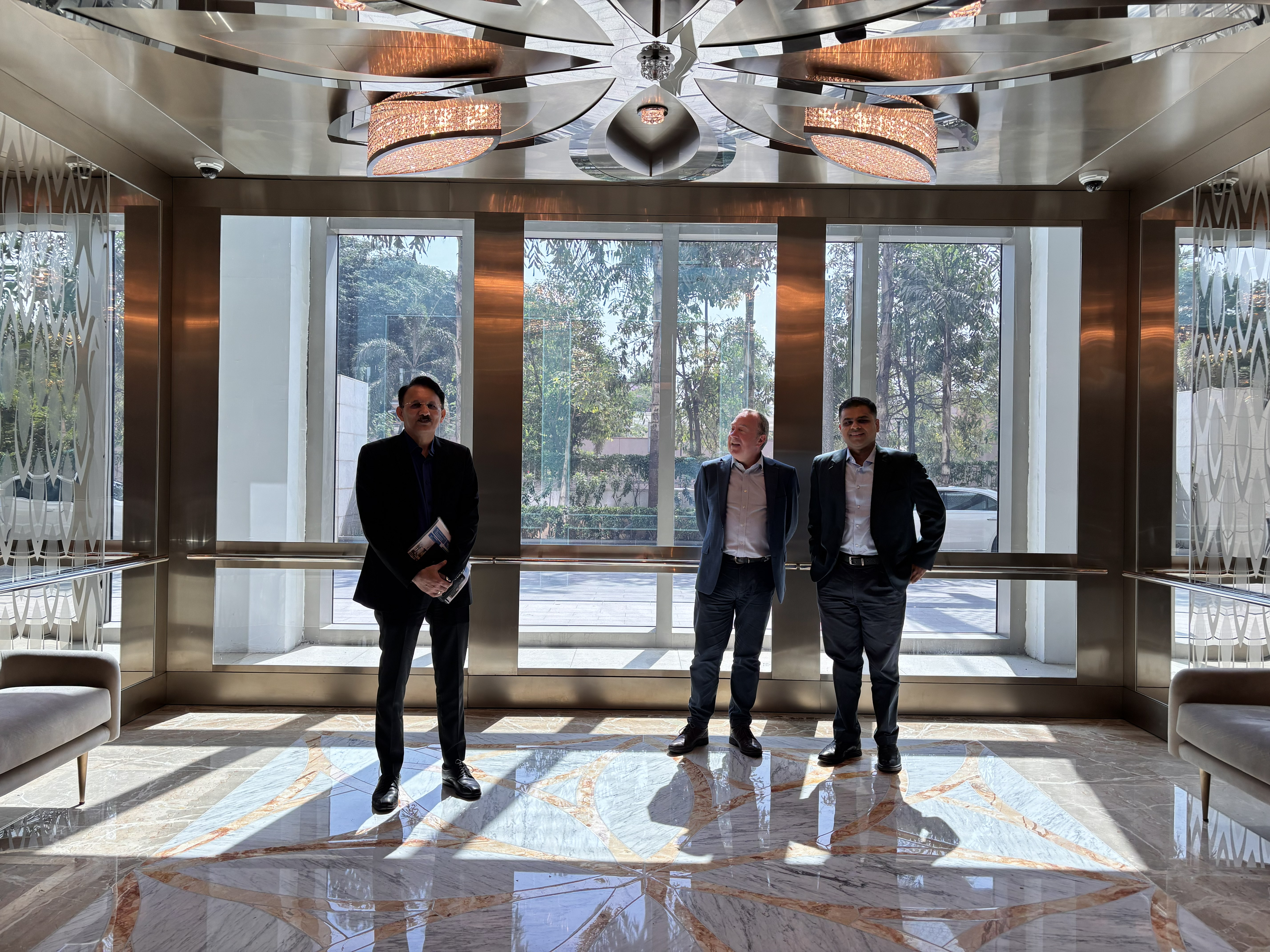
In Mumbai, this cultural reality even led to the installation of a 16-ton elevator, the largest of its kind, that can carry up to 235 people in a single trip at the Jio World Centre. It’s designed specifically to allow entire wedding parties to travel together between event spaces. It’s a powerful reminder that elevator design isn’t just about moving people efficiently on paper; it’s about responding to how people actually move, gather, and behave in real life.
These examples reinforce a broader point from the panel: successful vertical transportation design requires local knowledge, early questioning, and an openness to regional differences. When teams understand the cultural and behavioral context upfront, they can design systems that perform as intended, rather than discovering too late that the model didn’t match reality.
6. Designing for People: Psychology, Behavior, and User Experience
While elevator performance metrics like handling capacity and wait times remain important, panelist Ng emphasized that how people experience vertical transportation often matters just as much. In practice, elevators succeed or fail not only on technical performance, but on how intuitive, comfortable, and predictable they feel to the people using them every day.
One panelist described this as a psychological challenge as much as an engineering one. People perceive time differently when they are waiting, especially in crowded environments or unfamiliar buildings. A 30-second wait can feel acceptable in one context and frustrating in another, depending on visibility, crowding, noise, and how much control users feel they have.
Fairweather explained, “What we deal with is moving people… it’s all psychology. How people respond in a crowd, how they perceive waiting time.” In other words, two elevator systems with identical technical performance can feel completely different to occupants based on layout, signaling, destination dispatch logic, and how clearly the system communicates what’s happening.
This becomes especially important in mixed-use and high-density buildings, where different user groups — office workers, residents, hotel guests, visitors — share the same vertical transportation systems but have very different expectations. Designing with psychology in mind means anticipating peak anxiety moments, managing crowd behavior, and shaping the experience so movement feels orderly and predictable rather than chaotic.
By modeling real-world behavior and considering human response, not just theoretical performance, vertical transportation consultants help teams design systems that feel faster, calmer, and more intuitive in daily use. The result is not just better performance on paper, but a better experience for the people who rely on elevators every day.
Want a practical takeaway?
Download our checklist: Elevator Planning Considerations for New Buildings or watch the on-demand session recording to go deeper.
7. Why Codes Can’t Keep Up, and the Role of Global Best Practices
Across the discussion, panelists were clear that while codes are essential, they are often reactive rather than forward-looking. Codes typically evolve in response to incidents, new risks, or proven failures — and as a result, they struggle to keep pace with rapid changes in technology, building use, and user expectations.
“Codes can never keep pace with technology… that’s why we have a set of best practices and guides that we work toward,” Burns noted. In practice, this means that a building can be fully code-compliant and still fall short of modern performance, safety, or usability expectations.
Several experts pointed to fire and life safety as a clear example. In some regions, new evacuation standards and requirements for emergency-use elevators are being introduced, while in others those same ideas are still years away from formal adoption. Designing strictly to the minimum local code can leave buildings unprepared for future regulatory changes, or force costly retrofits when standards inevitably evolve.
This is where deep industry knowledge and global best practices play a critical role. By drawing on lessons learned across regions, such as accessibility improvements, enhanced communication systems, and evolving evacuation strategies, elevator consultants help project teams design systems that are not only code-compliant today, but resilient tomorrow.
The panel emphasized that best practices are not a replacement for code, but a way to design responsibly beyond it. When teams rely solely on local requirements, they risk locking buildings into outdated assumptions. When they design with global best practices in mind, they create vertical transportation systems that better support safety, flexibility, and long-term building performance.
8. Digitalization and Control Systems as Performance Drivers
While the basic mechanics of an elevator haven’t changed dramatically — it’s still a cab moving vertically within a shaft — our panel made it clear that where innovation is accelerating fastest is in digital control systems. These systems determine:
- How elevators respond to demand,
- How people are grouped and routed, and
- How the building communicates with users in real time.
Several panelists emphasized that control systems are increasingly what make modern buildings function well, especially when physical constraints limit traditional solutions.
In dense or reused buildings, where adding shafts or increasing core size isn’t feasible, smarter controls often become the primary lever for improving performance.
Destination dispatch and advanced algorithms in control systems can fundamentally change the experience of moving through a building. By grouping passengers more intelligently and reducing unnecessary stops, these systems help manage higher populations within fixed footprints, an especially common challenge in adaptive reuse projects and vertically dense cities.
Beyond movement efficiency, digitalization is also shaping monitoring and long-term operations. Remote monitoring and data-driven diagnostics allow issues to be identified earlier, sometimes before occupants even notice a problem. While panelists noted that early versions of these tools were sometimes positioned as add-on services, the focus is shifting toward using data to improve reliability, uptime, and user experience over the life of the building.
Taken together, these insights reinforce that digital control systems are no longer optional enhancements, they are central to how modern vertical transportation systems adapt, scale, and perform within today’s buildings, particularly when physical flexibility is limited.
Why Early Vertical Transportation Expertise Matters
Understanding global elevator trends is only the starting point. As projects move from concept toward schematic design and beyond, teams are quickly faced with decisions that have long‑term consequences: core layouts are locked in, performance assumptions are set, and flexibility becomes harder to recover later.
This is the moment where early involvement from experienced elevator consultants can make a meaningful difference.
Rather than entering the process once key decisions have already been made, expert consultants help teams translate design intent into practical, buildable strategies from the outset. Our role is to pressure‑test assumptions, model real‑world usage, and identify tradeoffs early, when there is still time to adjust course without cost or compromise.
This early guidance is valuable on projects of every size. For smaller or mid‑scale buildings, it helps avoid over‑ or under‑design that can affect budgets and day‑to‑day performance. For larger or more complex developments, it brings clarity and coordination across architecture, structure, sustainability, and long‑term operations.
The Key Takeaway
Elevator design is no longer a technical afterthought. It’s a strategic component of building value. As buildings become more complex, global, and sustainability-driven, vertical transportation must evolve alongside them.
The takeaway from our global experts is clear: design early, design flexibly, and design with people — both present and future — in mind.
This is why VDA expertise belongs at the table from day one.
Want a practical takeaway? Download the checklist: Elevator Planning Considerations for New Buildings.
About the Author
Michael Muñoz joined VDA in 2006. In addition to consulting expertise, he is responsible for the company’s overall strategic direction, guiding the organization, driving growth, and maintaining high standards of operation and governance, in addition to oversight on corporate initiatives, sales, and customer satisfaction.